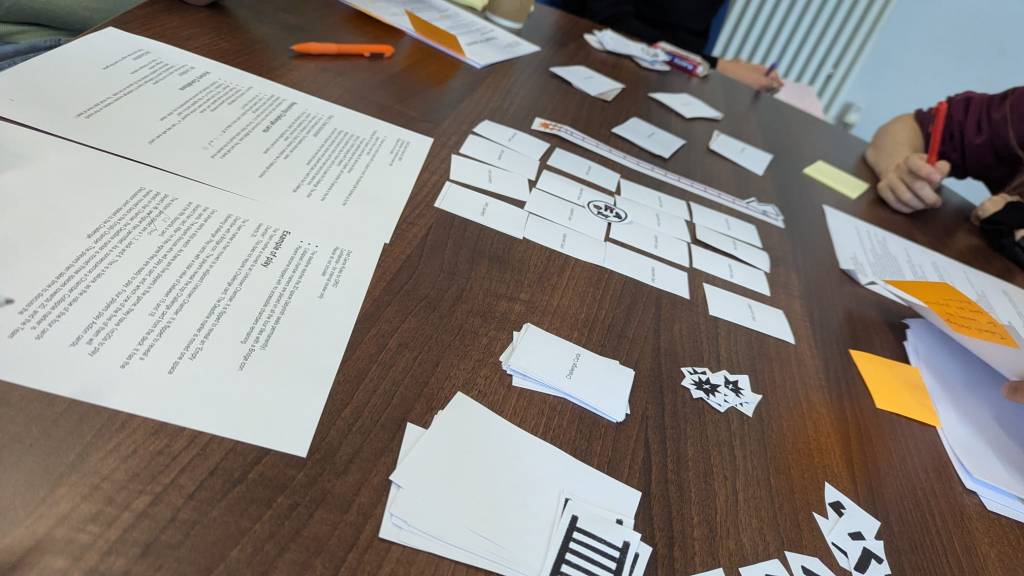
Games offer a great way to build teams and work through difficult discussions more openly.
Games for Research and Interdisciplinary Dialogue (GRID) is an interdisciplinary research project that tackles challenges in collaborative research.
The project is funded through the Research Culture Catalyst Fund, which was launched by InFrame to support small but impactful initiatives focused on inclusivity, leadership, and collegial values. The Culture Catalyst Fund is a £1M initiative aimed at improving research leadership and culture through innovative, collaborative projects that explore how research is led and the contributions of those involved in leadership.
InFrame itself is a major research culture initiative, bringing together the Universities of Glasgow, Edinburgh, and St Andrews through a £3M award from Wellcome. The aim is to build a new framework for inclusive research leadership, expand how leadership is defined, and strengthen research culture across the institutions.
GRID explores the challenges, techniques, and skills relevant to interdisciplinary research (IDR) and aims to bring these to research teams through a collaborative board game. Working with interdisciplinary researchers, students, technicians, and research support staff across the three universities, we will co-design a game that translates IDR challenges and solutions into practical, actionable game elements.
To gather diverse perspectives on the matter of IDR and to widen our reach and impact, GRID has partnered with Health Data Science UK (HDR UK) and UK Dementia Research Institute (UK DRI). The project is also part of the University of Edinburgh ‘Gamification and Systems Thinking Lab‘ and the University of Glasgow ‘Games and Gaming Lab‘, and is done in collaboration with the ‘Healthier Science through Collaboration’ (HxC) project.
The GRID Team
Inna Yaneva-Toraman – Project Lead, The University of Edinburgh
Agnessa Spanellis – Project Co-lead, The University of Edinburgh
Frank Siedlok – Project Co-lead, The University of St Andrews
Rachel Porteous – Project C0-lead, The University of Glasgow
Gabrielle Blackbell – InFrame Community Knowledge Analyst
James Buckley – Game Developer, Sapper Studio
Mollie MacGregor – Illustrations and Graphic Design
Project Collaborators
Amonida Zadissa – Associate Director of Informatics, UK DRI
Hollydawn Murray – Head of Open Science, Research Culture, & Impact, HDR UK
Project Structure
GRID will be carried through three phases:
Phase 1 – Co-Design
Two workshops will be carried with ‘interdisciplinarians’ from across the three universities. Workshop 1: Mapping Interdisciplinary Research Issues and Game Design will kickstart the project on 27th June 2025. This will be hosted by the University of Edinburgh and participants will engage in a variety of activities exploring IDR barriers and game design elements. Findings and material collected from the workshop will be then used by the GRID team to develop a game prototype.
In Workshop 2: Game Refinement, which will take place on 29th August 2025 at the University of Glasgow, we will play test and refine the game. Everything from game mechanics, to discussion topics, and learning outcomes will be explored and incorporated into the final test version of the game.
Phase 2 – Play Testing
The game will be tested in working research teams and data will be collected about its effectiveness and potential to improve collegiality, communication, and knowledge-sharing. GRID will work in collaboration with:
Healthier Science through Collaboration (HxC) – Funded by the UKRI Medical Research Council and led by Chris Ponting (University of Edinburgh), this project explores barriers and enablers in interdisciplinary collaboration in biomedical data science.
Failure Modes of Engineering (FeME) – Funded by the EPSRC Tomorrow’s Engineering Challenges Network Plus and led by Encarni Medina-Lopez (University of Edinburgh), this network addresses the unequal impact of climate change on women, children, and underrepresented communities, through improved engineering approaches.
TransiT Research Hub – Focused on decarbonising UK transport using digital twinning technologies, TransiT is led by Prof. Philip Greening (Heriot-Watt University) and David Flynn (University of Glasgow).
Phase 3 – Evaluation and Launch
Once playtesting is completed, the project team will analyse finding and evaluate the GRID game’s potential to create a research culture change. Any issues raised during the Play Testing phase will be explored and final refinements made to the game. In Workshop 3: Game Launch Event (late November TBC) we will launch the game and promote throughout the project networks. The GRID game materials will be made available on the websites of our partners HDR UK and UK DRI.

©GRID-project
Other than strictly as permitted by law you must not carry out on this website or its content any automated data mining, web scraping or other processes for extracting data or images.
 Inna Yaneva-Toraman